
Sulla LibertÀ
Il titolo originario di questo sito era Liberamente Libro. Anche se ora è cambiato lascio la pagina di presentazione perchè è interessante per capire alcune cose riguardo la libertà che non manca solo da oggi, e questo credo sia uno dei motivi principali per cui non riusciamo a mettere bene a fuoco l’argomento. Dato che ne sto scrivendo, mi sono detta che era bene lasciare questa introduzione.
Il Significato
Liberamente libro non significa solo che un libro ti rende libero, anche se succede. ‘Libro’ non significa libero, deriva dal sostantivo latino neutro liber, la corteccia dell’albero da cui venivano le pergamene, cioè i primi libri, che durante la declinazione perde la e.
Libertus, lo schiavo liberato, viene invece da liber aggettivo maschile, femminile e neutro, che mantiene la e.
Nel mondo latino alberi e uomini sembrano sovrapporsi, ma risalendo all’origine non solo la pronuncia è diversa, anche le radici: https://it.wiktionary.org/wiki/liber Per liber/corteccia dal proto italico lufros, dal proto indoeuropeo lewb /sbucciare e lew/tagliare.
Per liber/liberto dal latino arcaico loeber, dal proto italico louoeros, dal proto-indoeuropeo h lewdh eros da h lewd, persone, gente; etimologicamente collegato al greco antico eleutheros/libero e alla radice proto germanica liudiz/gente, dalla quale il tedesco leute/gente, il russo ljudi/gente.
Quindi da una parte gli uomini, liberi, schiavi o liberti, dall’altra la corteccia degli alberi su cui scrivere le loro storie.
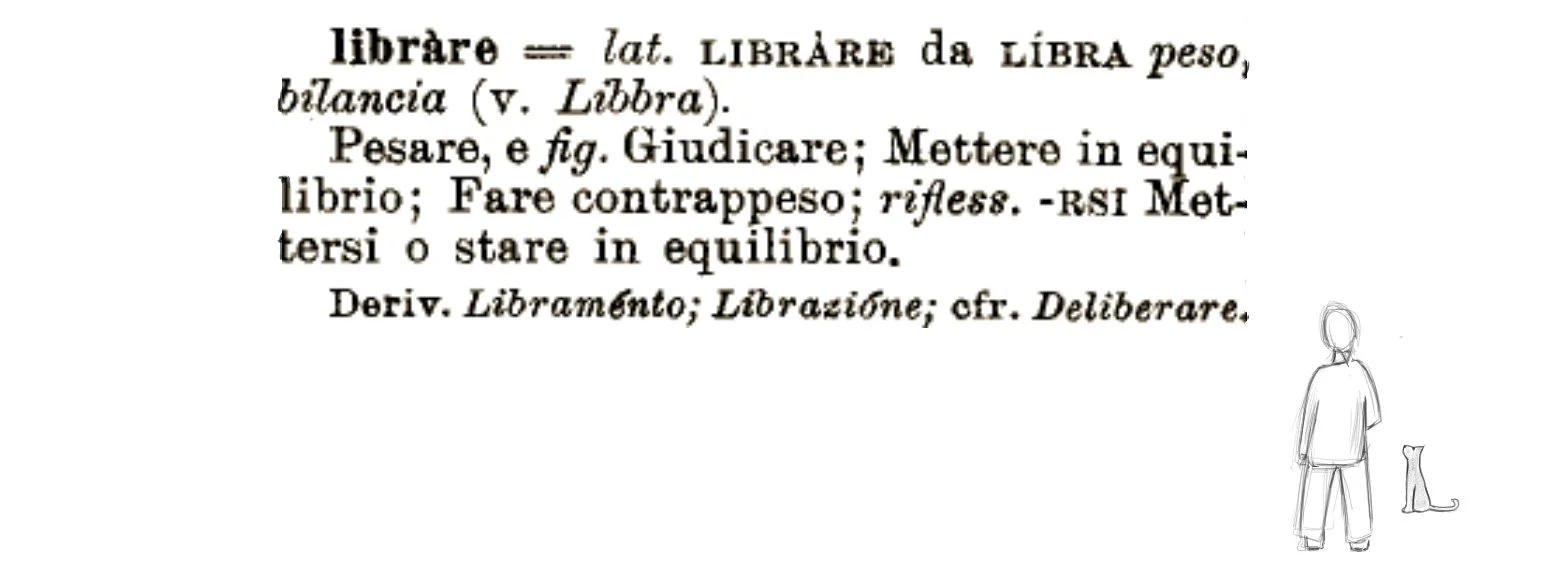
Libro qui si arricchisce di molti significati: libro che si legge o scrive liberamente, ma anche ‘libro’ prima persona del verbo ‘librare’ e del riflessivo ‘librarsi’. Librare è stare o mettere/si in equilibrio, mi libro è elevarsi in volo: senza equilibrio non ci si può né alzare da terra né mantenersi in volo.
Librare è anche soppesare, da qui la libbra usata nelle bilance dove per pesare bisogna usare un contrappeso come unità di misura. Nella realtà i nostri contrappesi sono i riferimenti e gli ancoraggi interiori, quindi l’uso della coscienza, e non ci si può esimere dall’esercitare le facoltà di valutazione e scelta, che presuppongono la percezione ampia di ciò che siamo, corpo, anima, psiche. Così un libro porta a nuove letture di sé.
Qui consideriamo la libertà connessa all’equilibrio e alla valutazione, cose che un buon libro porta in sé. Di fatto le società che le perdono non garantiscono più la libertà, e se non si è capaci di equilibrio e di valutare quello che accade dentro e fuori si può perdere la propria.
Allora si torna al paradigma insoluto tra libertà e genere umano, alla schiavitù che lo affligge dalla notte dei tempi, soprattutto quella non dichiarata, perché i liberti non erano liberi quanto chi nasceva libero, ma vivevano tutta la vita in libertà condizionata, condizione che da allora si è moltiplicata in modo esponenziale anche dove la schiavitù si dice vinta. Questo è un deterrente per l’evoluzione. Il fatto che si racconti che i liberti erano schiavi liberati è emblematico, non si sa se deriva dal rifiuto di considerare che la società una volta imposta la schiavitù non la toglieva mai del tutto, e in questo caso chi rifiuta questa verità, se tutta la società o il potere. Che questo sia vero basta vedere come oggi le condizioni di schiavitù siano cambiate e si siano estese quasi all’insaputa dei loro oggetti.
Ci sono però libri dove la finzione cessa e si parla di quello che accade senza veli, finiscono nelle mani di chi ha sete di verità e agiscono unendosi alla sua intenzione.
Per me sono “libri attivi”. Entrano nel flusso della realtà come nel sangue di una nuova generazione, accompagnano verso la mèta, sostengono, danno strumenti, parlano al cuore. Di libri così ne sono stati scritti molti, se ne scrivono di continuo, per fortuna, gettando un ponte tra dove siamo e dove ci porta la nostra evoluzione. Evolvere è la vera Rivoluzione, quella che non si può fermare e che non fallisce nel ritorno allo status quo.
About FreedoM
The original title of this site was Liberamente Libro. Although it's now changed, I'm leaving the introduction page because it's interesting for understanding a few things about the freedom that's not lacking just now, and I believe this is one of the main reasons we're struggling to get a clear focus on the topic. Since I'm writing about it, I decided it was best to leave this introduction out.
The Meaning
Liberamente libro doesn't just mean that a book makes you free, even if that happens. 'Libro' doesn't mean free; it comes from the neuter Latin noun liber, the bark of the tree from which parchments, i.e., the first books, came, which loses the e during the declension. Libertus, the freed slave, comes from liber, a masculine, feminine, and neuter adjective, which retains the e.
In the Latin world, trees and men seem to overlap, but going back to the origins, not only the pronunciation is different, but also the roots: https://it.wiktionary.org/wiki/liber
For liber/bark, from Proto-Italic lufros, from Proto-Indo-European lewb /to peel and lew/to cut. For liber/liberto, from Archaic Latin loeber, from Proto-Italic louoeros, from Proto-Indo-European h lewdh, eros, from h lewd, people, folk; Etymologically linked to the Ancient Greek eleutheros/free and the Proto-Germanic root liudiz/people, from which comes the German leute/people, and the Russian ljudi/people. So on the one hand, free men, slaves, or freedmen; on the other, the bark of trees on which to write their stories.
Book here takes on many meanings: book that is read or written freely, but also "book," the first person form of the verb "librare" and the reflexive "librarsi." To "librate" is to stand or balance, and to "libra" is to rise in flight: without balance, one can neither lift off the ground nor remain in flight.
To "librate" is also to weigh, hence the pound used in scales where a counterweight is used as a unit of measurement. In reality, our counterweights are our internal references and anchors, hence the use of our conscience. We cannot avoid exercising our faculties of evaluation and choice, which presuppose a broad perception of who we are—body, soul, and psyche. Thus, a book leads to new interpretations of ourselves.
Here we consider freedom as connected to balance and evaluation, things a good book embodies. Indeed, societies that lose these no longer guarantee freedom, and if one is incapable of balance and evaluating what happens inside and outside, one can lose one's own. We then return to the unresolved paradigm between freedom and humanity, to the slavery that has plagued it since the dawn of time, especially the undeclared kind, because freedmen were not as free as those born free, but lived their entire lives in conditional freedom, a condition that has since multiplied exponentially even where slavery is said to have been defeated. This is a deterrent to evolution. The story that freedmen were freed slaves is emblematic. It's unclear whether this stems from a refusal to consider that once society imposed slavery, it never completely abolished it. And in this case, who is rejecting this truth, whether society as a whole or those in power? That this is true is sufficient to see how today the conditions of slavery have changed and spread almost unbeknownst to their subjects.
There are, however, books where fiction ceases and what happens is spoken of openly; they end up in the hands of those who thirst for truth and act by uniting with their intention.
For me, they are "active books." They enter the flow of reality like the blood of a new generation, accompanying one toward the goal, supporting, providing tools, speaking to the heart. Many books like this have been written, and fortunately, they are continually being written, building a bridge between where we are and where our evolution is leading us. Evolving is the true Revolution, the one that cannot be stopped and that does not fail to return to the status quo.